
Waterfront Ice Protection
Marina Bubbler Systems
Compressed-air bubbler systems for docks, pilings, slips and waterfront infrastructure exposed to winter ice.
Marina Bubbler Systems

Vacuum pumps play a crucial role in the slurry preparation process for lithium battery production, particularly in degassing the slurry to ensure the integrity and performance of the electrodes. Here's how vacuum pumps are typically used in this process:
In summary, vacuum pumps are essential in the slurry preparation process for lithium battery production, enabling efficient solvent removal, gas degassing, contamination prevention, and enhancing the quality and consistency of electrode coatings.


Drying the coated electrodes under vacuum is a crucial step in lithium battery production to ensure minimal residual moisture content. Here's how this process typically works:
Overall, vacuum drying of coated electrodes plays a critical role in lithium battery production by ensuring that residual moisture is minimized, which helps to maintain the performance, stability, and safety of the final battery products.

The Role
As the Applications/Inside Sales Specialist, you will play a crucial role in providing direct support to our customers and sales team/resellers. You will be responsible for answering inquiries related to our company's offerings, which include vacuum pumps, air compressors, PD blowers, and other rotating equipment. In this role, you will be involved in sizing, costing, and quoting equipment supplied by CompreVac, as well as in-house designed and built systems. You will also be responsible for tracking workload and opportunities through various tools, including web-based platforms and customer relationship management (CRM) software. Overall, your role will be critical in ensuring that our customers receive timely and accurate information about our products and services, helping to drive sales and contribute to the ongoing success of our business.

Factory trained staff both inside the workshop and offices of CompreVac Inc as well as on the road as service technicians and sales representatives.

Product knowledge, beit a spare part or original equipment, we have the answer you need and expect at CompreVac Inc.

It's 2022 - why are you waiting for others to reply to your request. Go online at aironline.ca and get pricing in real time.
CompreVac supplies vacuum pumps, blowers, compressors and engineered systems for manufacturing, process industries, laboratories, marinas and specialized industrial applications throughout Canada.
Industrial vacuum, blower and compressed-air equipment should be selected around the application rather than horsepower or connection size alone.
Required flow, vacuum level, pressure, gas or vapour load, operating hours, environmental conditions and system losses can all affect the correct equipment choice.
CompreVac works with industrial customers to evaluate the complete process and select suitable vacuum pumps, blowers, compressors, controls and engineered system components.
Explore common applications supported by CompreVac equipment and engineering expertise.
Compressed-air bubbler systems for docks, pilings, slips and waterfront infrastructure exposed to winter ice.
Marina Bubbler Systems
Industrial vacuum for slurry preparation, degassing, electrode processing and vacuum drying.
Battery Vacuum Applications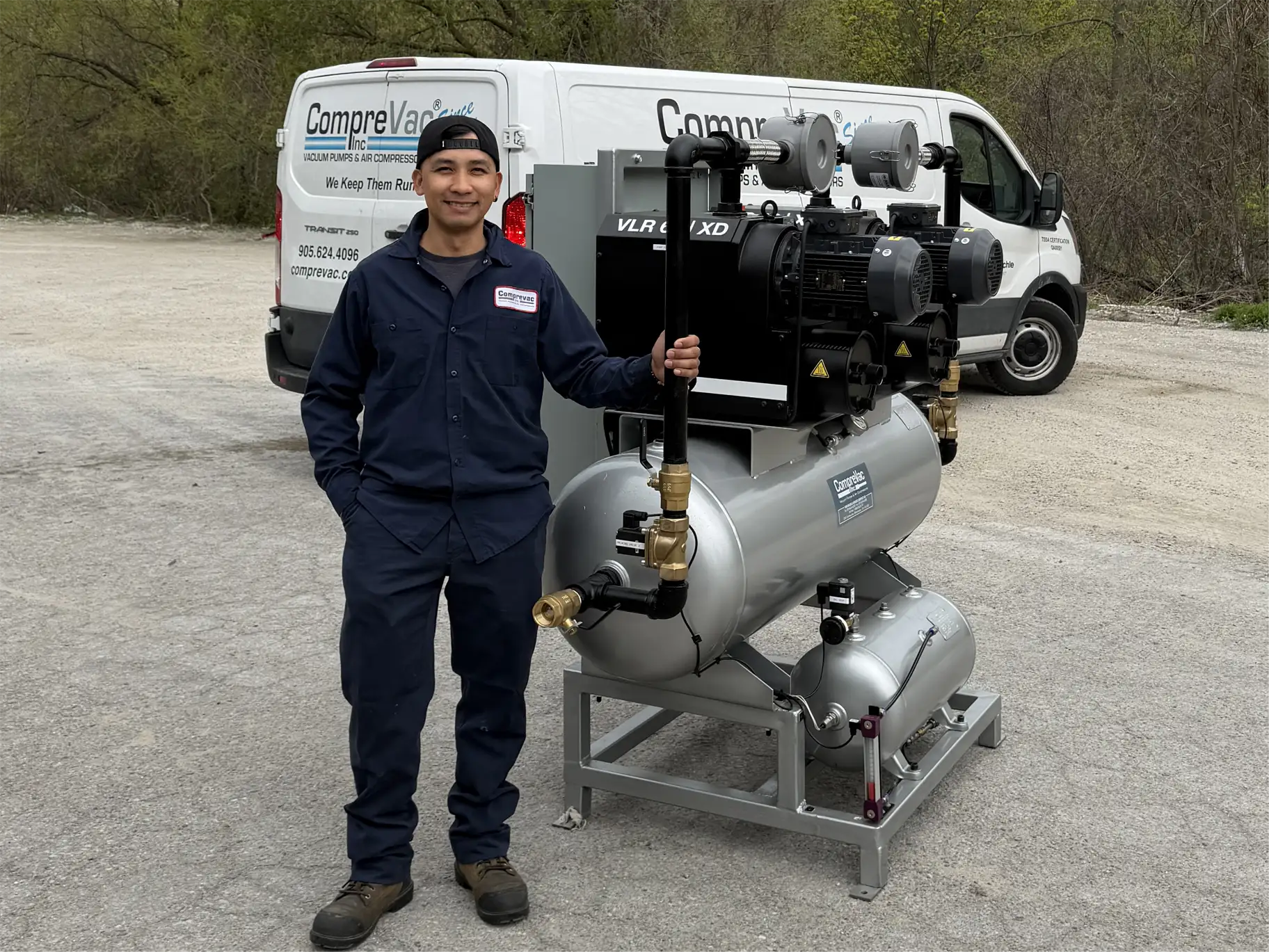
Vacuum priming systems for centrifugal pumps used in municipal, industrial and water-handling applications.
Pump Priming Systems
Vacuum pumps for removing moisture, air and entrained gases from industrial materials and process equipment.
Industrial Vacuum Pumps
Packaged duplex and triplex vacuum systems for multiple production machines and plant-wide vacuum requirements.
Engineered Systems
Vacuum and positive-pressure equipment for conveying powders, granules and process materials.
Discuss Pneumatic Conveying
Compressed-air marina bubbler systems help maintain water movement around docks, pilings, boat slips and other waterfront structures. This circulation can reduce solid ice formation and the mechanical forces associated with freeze-up.
CompreVac can help evaluate the required airflow and pressure based on water depth, piping distance, number of bubbling zones and the overall marina layout.
Lithium-ion battery manufacturing can use vacuum at several stages including slurry preparation, degassing and electrode drying.
The required pump technology depends on vacuum level, pumping speed, process vapours, production cycle and contamination requirements.
Evacuation for food, manufacturing and protective packaging processes.
Industrial vacuum for thermoforming and plastics manufacturing equipment.
Low-pressure air and blower systems for suitable treatment and aeration duties.
Vacuum and pressure for sheet handling, printing and converting equipment.
Vacuum, low-pressure air and gas handling for production and packaging processes.
Vacuum for resin processing, forming, degassing and manufacturing equipment.
Process vacuum for controlled production, drying and material handling.
Vacuum pumping systems for heat treatment and controlled-atmosphere processing.
No single vacuum pump or blower technology is correct for every application. Pumping speed, operating pressure, vapour handling, noise, maintenance and energy use should all be considered.

Elmo Rietschle manufactures a broad range of industrial vacuum technologies including screw, claw, rotary vane, side-channel and vacuum booster equipment.
CompreVac supplies and supports Elmo Rietschle equipment while providing application engineering, system design, on-site service and workshop repair support from Mississauga, Ontario.
Common questions about selecting vacuum pumps, blowers and compressed-air equipment for industrial processes.
Vacuum pumps are used in applications including drying, degassing, packaging, forming, material handling, battery manufacturing, vacuum furnaces, pump priming and centralized industrial vacuum systems.
A marina bubbler system uses compressed air released beneath the water surface to create circulation around docks, pilings and other waterfront structures. The circulation can help reduce solid ice formation during winter.
Sizing depends on water depth, total airflow, number of bubbling points, piping distance, pipe diameter and pressure losses. CompreVac can review these factors as part of the system design.
Vacuum can be used during battery slurry degassing and electrode drying to remove entrained gases, residual process liquids and moisture.
A vacuum priming system removes air from the suction side of a centrifugal water pump so the pump can become flooded and begin pumping liquid.
Yes. Central vacuum systems can serve multiple production machines when correctly sized for simultaneous demand, piping losses and required operating pressure.
Vacuum pumps are generally selected where a lower absolute pressure is required, while blowers typically provide higher gas flow at lower pressure differentials. The correct choice depends on the application.
Yes. CompreVac can supply individual pumps or complete packaged systems incorporating pumps, controls, filtration, receivers, piping and supporting equipment.
Yes. CompreVac provides on-site service as well as workshop servicing, repair and rebuild support from Mississauga, Ontario.
Selection should consider operating vacuum, pumping speed, process gas and vapours, duty cycle, installation conditions, energy use and required system redundancy.
Send CompreVac your required flow, vacuum or pressure, process details and operating conditions. We can help identify the appropriate equipment and system configuration.