
Selling and servicing all makes of air compressors and vacuum pumps across Canada since 1975. A company you can trust. A company with integrity. CompreVac Inc.


Compact oil-less rotary vane pumps and compressors designed for OEM applications requiring high flow relative to pump size, low pulsation and low vibration.
Thomas rotary vane technology is widely used for vacuum handling, gas sampling, medical devices, laboratory equipment and industrial systems where consistent flow and compact dimensions are critical.
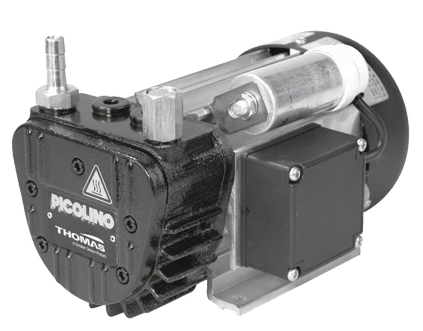
Thomas rotary vane pumps are often selected where an OEM device requires relatively high airflow from a compact pump package.
Rotary vane technology provides smooth gas transfer with low pulsation and low vibration, helping maintain consistent airflow while reducing mechanical disturbance to the surrounding equipment.
These characteristics make Thomas rotary vane pumps particularly useful for vacuum handling, gas sampling, inflation and deflation, analytical equipment and other applications requiring continuous, controlled gas movement.
Thomas rotary vane platforms cover a broad flow range while maintaining compact dimensions and smooth, low-pulsation operation.
Approximately 0.04 CFM at the compact end of the rotary vane range.
Up to approximately 7.0 CFM depending on pump configuration.
Equivalent to approximately 27.5 inHg vacuum.
Equivalent to approximately 14.5 PSI.
Rotary motion delivers consistent flow with minimal pressure pulsation.
Smooth operation helps minimize vibration transferred to surrounding equipment.
Rotary vane technology delivers one of the highest flow-to-size ratios within the Thomas gas pump portfolio.
Strong airflow capability from a compact pump simplifies integration into space-constrained OEM equipment.
Rotary gas movement creates smoother flow than many reciprocating pump technologies.
Smooth rotation helps reduce mechanical vibration transmitted to sensitive instruments and devices.
Self-lubricating vane materials eliminate the need for lubricating oil in the pumped gas path.
Selected designs can reverse direction, enabling active inflation and deflation from the same pump.
Vane count, material, orientation and motor selection can be tailored around specific application requirements.
Thomas rotary vane pumps can be configured mechanically and electrically to match demanding OEM equipment requirements.
Vane count can be adjusted to tailor airflow, performance and operating characteristics.
Selected configurations allow vane orientation to support reversible pump operation.
Plastic or carbon head and vane materials can be selected according to the application.
Multiple AC and DC drive technologies are available to match electrical requirements.
Pump design can be optimized around required airflow and system backpressure.
Mechanical and electrical configuration can be adapted to fit finished machinery.
Material selection allows Thomas rotary vane pumps to be optimized around moisture exposure, sound, leakage and performance requirements.
Plastic head and vane configurations are recommended for humid operating environments where moisture tolerance is an important application consideration.
Carbon components can reduce leakage, improve sound quality and provide tighter manufacturing tolerances for improved pneumatic performance.
Compact size, high airflow and smooth operation make rotary vane technology suitable for medical, laboratory and industrial OEM equipment.

A rotary vane pump is a positive-displacement pump using a rotating slotted rotor mounted inside a cylindrical pump chamber.
Thomas rotary vane pumps can be paired with several drive technologies to match voltage, efficiency, controls, lifetime and OEM system requirements.
Pump selection should consider the complete operating requirement, including flow, vacuum or pressure, environment, electrical supply and integration constraints.
Common engineering questions about Thomas rotary vane vacuum pumps and compressors.
A Thomas rotary vane pump is an oil-less positive-displacement pump using a rotating slotted rotor and sliding vanes to move air or gas and generate either pressure or vacuum.
Thomas rotary vane pumps cover free-flow rates from approximately 1.2 L/min or 0.04 CFM up to approximately 198 L/min or 7.0 CFM.
Depending on the model, continuous vacuum capability extends up to approximately 930 mbar vacuum, equivalent to around 27.5 inHg.
Thomas rotary vane compressors can provide continuous pressure up to approximately 1 bar or 14.5 PSI, depending on the model.
Yes. Thomas rotary vane pumps use oil-less, self-lubricating materials and do not require lubricating oil in the pumped gas path.
Selected series can use vane orientation that permits reversible flow, making them particularly useful for applications requiring active inflation and deflation.
Thomas offers plastic and carbon head and vane configurations. Plastic versions provide moisture tolerance for humid environments, while carbon components can improve leakage control, sound quality and dimensional precision.
Yes. CompreVac can assist with pump selection based on airflow, pressure or vacuum, motor type, voltage, environmental conditions, materials, duty cycle and OEM installation requirements.
Contact CompreVac with your required airflow, pressure or vacuum, voltage, operating environment and application details. We can help identify the appropriate Thomas rotary vane vacuum pump or compressor for your OEM equipment.
Rotary vane pumps are often the first choice for vacuum handling and gas sampling applications that require a high flow capability relative to the size of the pump.
Rotary vane technology features low pulsation and low vibration, which enable consistent flow rates with minimal vibration. These traits make these units ideal for Medical, Lab Life Science devices, life-saving equipment, and Industrial, Environmental, and Food & Beverage markets.
Rotary Vane Pumps by Thomas
Thomas rotary vane pumps and compressors provide a free flow ranging from 1.2 l/min (0.04 cfm) up to 198.0 l/min (7.0 cfm), with maximum continuous operating vacuum up to 930 mbar (27.5 in.Hg), and maximum continuous operating pressures up to 1 bar (14.5 psi).Our rotary vane portfolio can be driven by various drive options. Customers can choose from Ironless Core DC, Permanent Split Capacitor (PSC), Split Phase (SP), Permanent Magnet DC (PM), and Brushless DC (BLDC) options.
Benefits of Thomas Rotary Vane Pumps and Compressors
These oil-less and self-lubricating units provide the highest flow to size ratio and lowest pulsation of all five gas technologies offered by Thomas. Rotary vane technology can feature an orientation of vanes that enables for a reversible direction of flow in selected series. That makes them an ideal component for applications that require active inflation and deflation, such as in medical compression sleeves for deep vein thrombosis.
Perfect Fit for a Variety of OEM Devices
Original Equipment Manufacturers that need a compact-sized unit with outstanding performance as well as high flow with minimal backpressure, often reach for Thomas rotary vane products. This technology is the perfect fit for applications that require high flow to size ratio.These components have a proven record of successful utilization in a wide range of industries and applications. Thanks to the reversible flow direction, some components are a perfect fit for the application requiring inflation or deflation, or intake and outtake motion.
Featured Applications using Rotary Vane Pumps and Compressors
Customized For Your OEM Needs
Thomas’ Rotary Vane pumps and compressors can be customized to meet even the most complex requirements of the customer. On top of that, their design allows them to tailor the performance by adjusting the number of vanes, varying the component materials and motor selection to meet the performance range required in a given application. We offer a selection of plastic and carbon head/vane material that can be selected based on the operating environment or media being pumped.Plastic head and vane configured models are recommended for use in humid environments due to moisture tolerance. Carbon head and vane components provide improved performance compared to plastic parts. Carbon components reduce leakage, improve sound quality, and offer more precise tolerances.Apart from the different composite materials, our engineers can customize the number of vanes in the pump head and their orientation. That enables the pump-head to run also in reverse motion.
How Rotary Vane Pumps and Compressors Work?
The rotary vane unit cylindrical head consists of a rotor with slots for vanes (pump blades). The rotary vane pump uses centrifugal force to push the vanes against the cylindrical head/housing wall and slide against the cylinder's internal surface as the rotor turns.This movement creates a gap between the two vanes and the cylinder. As the rotor turns, the gap is being moved, and the volume of the gas is being compressed, increasing the pressure and creating a vacuum.Construction of these positive displacement pumps allows us to create units smaller than the coin that can still provide amazing performance for thousands of hours.