Reliable Pump Startup
Ensures centrifugal pumps are fully primed before startup for dependable operation.


Automatic vacuum priming systems for municipal water, wastewater, sewage, stormwater and industrial centrifugal pump installations. CompreVac designs and supplies complete priming systems for reliable, automatic pump startup and protection against loss of prime.
Ensures centrifugal pumps are fully primed before startup for dependable operation.
Helps prevent cavitation, overheating and dry running caused by loss of prime.
Vacuum controls monitor system conditions and automatically manage the priming sequence.
Complete packages can include vacuum pumps, separators, receivers, controls and panels.
A vacuum pump priming system removes air from a centrifugal pump casing and suction line so that liquid can rise through the suction piping and fill the pump before startup.
Centrifugal pumps are designed to move liquid rather than air. If the pump casing or suction line contains excessive air, the pump may fail to develop normal flow and can be exposed to cavitation, overheating or dry running.
An automatic vacuum priming system removes that trapped air and confirms prime before the main centrifugal pump is started.
The vacuum system evacuates air from the centrifugal pump and suction line, allowing atmospheric pressure to push liquid upward until the pump is completely primed.
The vacuum pump evacuates trapped air from the centrifugal pump casing and suction piping.
As pressure falls in the suction line, atmospheric pressure pushes liquid upward toward the centrifugal pump.
Vacuum controls confirm the required priming condition before the centrifugal pump is permitted to start.
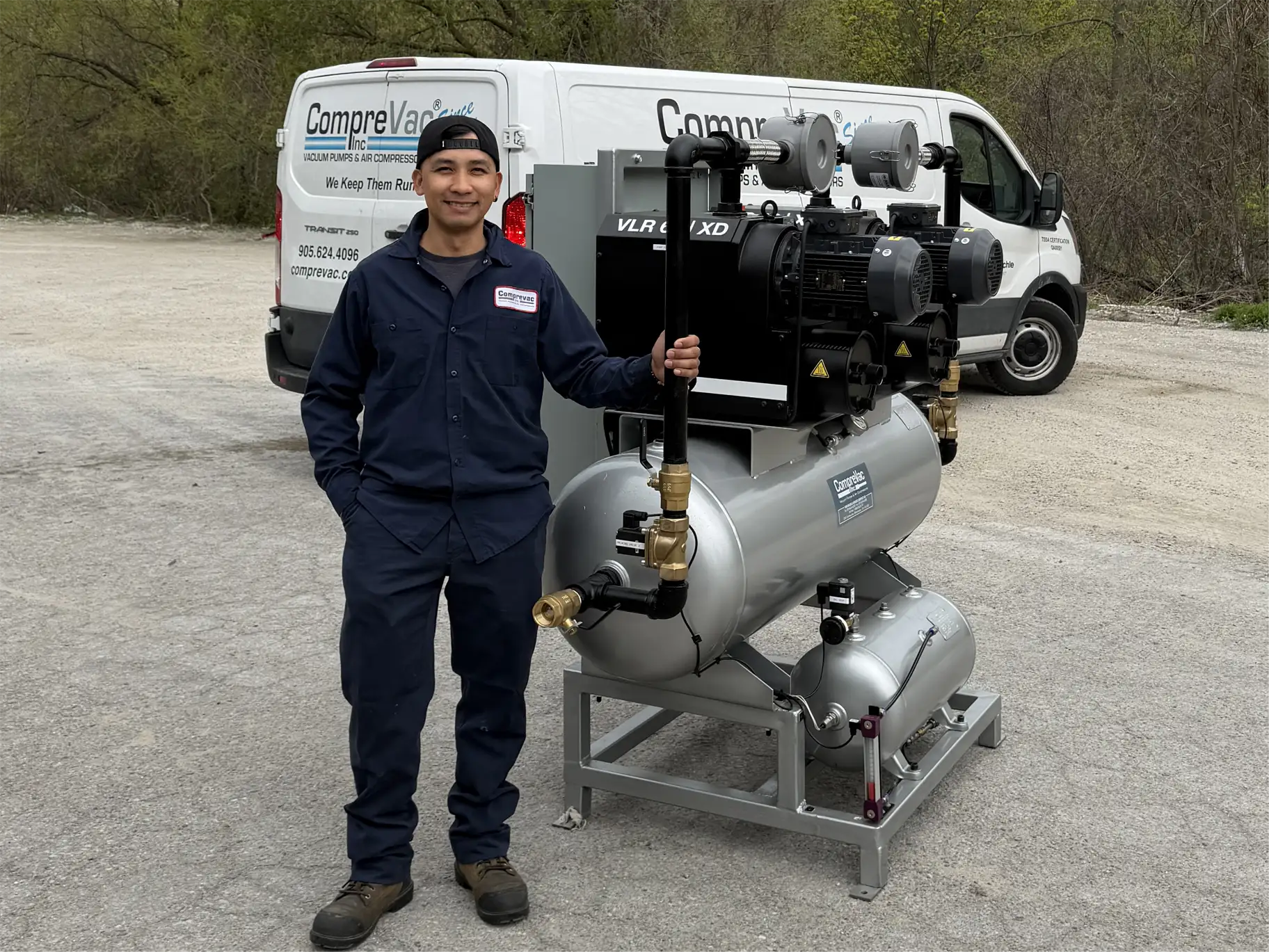
A reliable priming system must be designed around the complete centrifugal pump installation, not simply selected from a vacuum pump airflow number.
CompreVac can integrate the vacuum pump, separator, float protection, receiver, valves, controls and electrical panel into a complete automatic priming package.
Systems can be built for new stations, equipment replacement or retrofit projects where an existing priming arrangement has become unreliable or obsolete.
The exact configuration depends on the application, but a complete priming package typically includes the following core components.
Creates the vacuum required to evacuate air from the centrifugal pump and suction piping.
Separates entrained liquid from evacuated air before it reaches the vacuum pump.
Provides liquid protection by helping prevent separator carryover into the vacuum pump.
Monitor vacuum level and automatically initiate or stop the priming cycle.
Provides automatic sequencing, alarms and integration with station controls.
Stores vacuum capacity for rapid response or repeated priming requirements.
CompreVac can configure the vacuum system around the required level of capacity and redundancy for the pumping station.
One vacuum pump provides priming capacity where standby redundancy is not required.
Two vacuum pumps can provide duty/standby operation or automatic lead-lag sequencing.
Three vacuum pumps provide additional capacity and redundancy for critical pump stations.
The correct vacuum pump and receiver size depend on the actual air volume that must be removed, the required priming time and the suction conditions of the centrifugal pump installation.
Vacuum priming is particularly valuable where centrifugal pumps are installed above the liquid level or where automatic unattended startup is required.
Automatic priming of centrifugal pumps in potable and process-water installations.
Reliable pump priming for treatment plants and wastewater transfer systems.
Automatic priming for pumps handling sewage and wastewater applications.
Rapid priming of drainage and stormwater pumps during changing water levels.
Priming systems for pumps drawing from reservoirs, rivers and other water sources.
Reliable unattended priming for drainage and flood-control pumping stations.
Automatic priming for cooling water, process water and industrial transfer systems.
Priming of centrifugal pumps installed above canals, reservoirs or water storage.
A vacuum pump priming system removes air from a centrifugal pump casing and suction line so that liquid can rise into the pump before startup.
Centrifugal pumps are designed to move liquid rather than air. The pump casing and suction line must contain sufficient liquid before the pump can develop normal flow.
The pump may fail to produce flow, cavitate, overheat or run dry. Continued operation can damage seals and other pump components.
Yes. Vacuum switches or electronic sensors can automatically initiate the priming system and confirm the required vacuum condition before startup.
Yes. A centralized vacuum priming system can serve multiple centrifugal pumps when the vacuum capacity, receiver, valves, controls and piping are correctly sized.
A self-priming centrifugal pump uses retained liquid and internal casing geometry to remove air. A separate vacuum priming system actively evacuates air from a standard centrifugal pump and suction line.
The separator removes entrained liquid from the evacuated air and helps prevent liquid from entering and damaging the vacuum pump.
Yes. The priming control panel can provide vacuum status, pump status, alarms, faults and other operating signals to the station PLC or SCADA system.
The theoretical maximum suction lift for water at sea level is approximately 10.3 m or 33.9 ft. Practical suction lift is lower because of elevation, water temperature, vapour pressure, piping losses and air leakage.
Yes. CompreVac can assess an existing vacuum priming system and provide replacement or retrofit equipment based on the centrifugal pumps, suction piping and required operating sequence.
Send CompreVac your centrifugal pump size, suction-pipe dimensions, vertical suction lift and required priming time. We can help size the vacuum system and develop the appropriate single, duplex or triplex package.
A vacuum pump priming system automatically removes air from centrifugal pump casings and suction lines, allowing pumps to fill with liquid before startup. It prevents dry running, reduces manual intervention, improves reliability and ensures dependable operation in municipal water, wastewater and industrial pumping stations.