Freeze Drying
Deep vacuum for laboratory freeze dryers and lyophilization processes.


Reliable laboratory vacuum and precision liquid handling solutions for research, chemical processing, filtration, freeze drying, distillation and scientific applications.
CompreVac supplies Welch DUOSEAL, CHEMSTAR, CRVpro, diaphragm and dry piston vacuum pumps, together with the new LP500 peristaltic pump series, for laboratories, universities and research facilities across Canada.

Laboratory pumping requirements vary considerably. Vacuum applications may require deep ultimate pressure, chemical vapor resistance, quiet operation or an oil-free pumping chamber to protect sensitive samples.
Welch offers belt-drive rotary vane pumps, direct-drive rotary vane pumps, dry piston pumps and oil-free diaphragm pumps for different vacuum operating requirements.
For liquid transfer, dosing and filling applications, the Welch LP500 peristaltic pump series provides digitally controlled flow with convenient tubing replacement and flexible operating modes.
CompreVac helps Canadian laboratories select suitable equipment based on the actual process, operating conditions and performance requirements.

Welch supports a broad range of laboratory vacuum and precision fluid handling applications.
Deep vacuum for laboratory freeze dryers and lyophilization processes.
Deep vacuum for air-sensitive chemistry, inert-gas manifolds and research laboratories.
Controlled vacuum for laboratory drying, curing and thermal processing.
Moderate controlled vacuum for membrane filtration and sample preparation.
Remove dissolved gases from resins, liquids, oils and laboratory materials.
Vacuum support for solvent evaporation where pump chemistry and vapor handling matter.
Reduced-pressure distillation for heat-sensitive and high-boiling compounds.
Evacuation and vacuum support for controlled-atmosphere laboratory equipment.
Backing or process vacuum for suitable scientific and analytical equipment.
Controlled liquid transfer using Welch LP500 peristaltic pump technology.
Precise liquid handling for bacterial and cell-culture laboratory processes.
Repeatable dispensing and liquid movement for research and process laboratories.
Explore Welch laboratory vacuum pumps and precision fluid handling equipment. Select the appropriate technology for your application.
Welch belt-drive rotary vane pumps provide deep vacuum for demanding laboratory and research processes. CHEMSTAR models are designed for applications requiring increased resistance to chemical vapors.

CRVpro two-stage direct-drive rotary vane pumps provide deep vacuum across a broad pumping-speed range for laboratory research, freeze drying, vacuum ovens and scientific processes.

Dry WOB-L piston pumps provide an oil-free vacuum source for laboratory applications that do not require deep rotary-vane vacuum.
Welch diaphragm pumps provide clean, oil-free laboratory vacuum with low routine maintenance and no lubricating-oil back-streaming into sensitive processes.
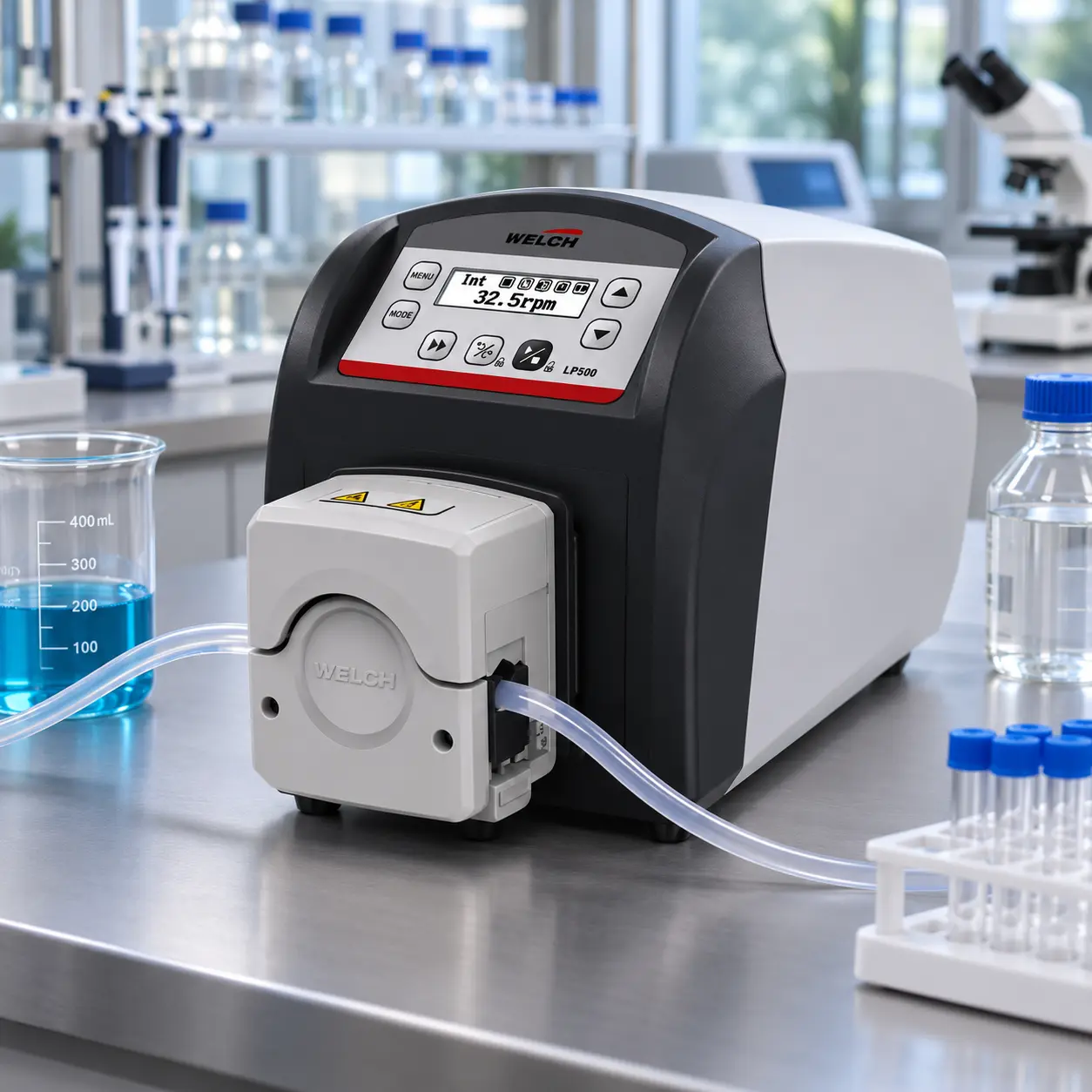
The Welch LP500 series combines precision digital speed control, quick-change tubing and dependable liquid transfer for demanding laboratory applications.
Available in two configurations, the LP500-L and LP500-H, the series provides flow rates up to 1,955 mL/min with flexible internal and external control.
A pump that works well for filtration may be completely unsuitable for freeze drying or solvent distillation. The process should determine the technology.
Rotary vane pumps are commonly used where laboratory processes require vacuum well below the range of dry piston or standard diaphragm pumps.
Diaphragm and dry piston pumps eliminate oil from the pumping chamber and avoid lubricating-oil back-streaming into the process.
Laboratory solvents and corrosive vapors can require CHEMSTAR or chemically resistant diaphragm technologies.
Water vapor, solvents and condensable gases can strongly affect vacuum pump reliability and should be considered during selection.
Chamber size, process leakage and vapor load determine the pumping speed required at the actual operating vacuum.
The right vacuum technology can reduce contamination risk and help protect sensitive laboratory samples and processes.
Do not select a vacuum pump only from its ultimate vacuum specification. The complete laboratory process determines the correct pump.
Answers to common questions about Welch laboratory vacuum pumps and precision fluid handling equipment.
The best laboratory vacuum pump depends on the required vacuum level, pumping speed, vapor load and chemical compatibility. Rotary vane pumps are often selected for deeper vacuum, while diaphragm and dry piston pumps are useful where oil-free operation is preferred.
Freeze drying normally requires a deep-vacuum pump capable of reaching well below the vacuum range of most general-purpose dry pumps. Welch rotary vane pumps are commonly suited to laboratory freeze-drying applications when correctly sized.
Schlenk-line chemistry generally requires deep vacuum for air-sensitive work. Suitable Welch CRVpro, DUOSEAL or CHEMSTAR models may be considered depending on the chemicals and vapors present.
Yes. Welch rotary vane, diaphragm or dry vacuum pumps may be suitable depending on required vacuum, chamber size, process temperature and vapors released from the material inside the oven.
Yes. Welch diaphragm and dry piston technologies provide laboratory vacuum without lubricating oil in the pumping chamber.
Oil-free pumps eliminate oil back-streaming into the laboratory process and remove the need for vacuum-pump oil changes. They can be attractive for filtration, sample preparation and contamination-sensitive applications.
CHEMSTAR is a chemically resistant belt-drive rotary vane vacuum pump family designed for laboratory applications involving harsh or corrosive vapors.
Welch CRVpro two-stage rotary vane pumps can achieve ultimate pressure down to approximately 2 × 10⁻³ Torr depending on the model and conditions.
The CRVpro range covers free-air displacement from approximately 1.8 CFM to 45.9 CFM.
Yes. Diaphragm pumps are commonly useful for filtration where the pump provides sufficient flow and vacuum and the wetted materials are compatible with the gases and vapors in the application.
Certain Welch pumps are intended for chemical and solvent-vapor applications. The correct pump depends on the solvent, concentration, temperature and vapor load. Chemical compatibility should always be confirmed.
The correct degassing pump depends on the material, required final pressure, gas load and process volume. Dry pumps may suit moderate vacuum, while deeper degassing applications may require rotary vane technology.
The Welch LP500 is designed for controlled liquid transfer, dosing and filling in laboratory environments. Applications include chemical synthesis, cell culture, density gradient tube filling and general fluid handling. It is a liquid handling pump, not a vacuum pump.
The LP500-L is the low-flow configuration using 3.2 mm and 4.8 mm ID tubing, with flow rates up to 1,170 mL/min at 600 rpm. The LP500-H uses 6.4 mm and 8.0 mm ID tubing, with flow rates up to 1,955 mL/min at 600 rpm. Continuous-duty operation is rated up to 400 rpm.
CompreVac supplies Welch laboratory pumping equipment in Canada. Visit the Welch LP500 product page for model information, specifications and Canadian quotation enquiries.
Yes. For vacuum applications, provide the required operating pressure, chamber volume, pumping speed, process vapors and duty cycle. For fluid handling, provide the required liquid flow, fluid compatibility, tubing requirements and operating conditions.
Whether your application involves deep vacuum, chemical processing, laboratory filtration or precision liquid handling, CompreVac can help identify the appropriate Welch pumping technology. Contact us with your requirements.
Laboratory vacuum pumps for freeze drying, Schlenk lines, vacuum ovens, filtration, degassing, distillation, analytical instruments and general research laboratory vacuum applications.
CompreVac supplies Welch DUOSEAL, CHEMSTAR, CRVpro, diaphragm and dry piston vacuum pump technologies for laboratories, universities, research facilities and life-science applications across Canada.
Laboratory vacuum is different from general industrial vacuum. A pump may need to achieve deep ultimate pressure, tolerate solvent vapors, run beside research staff, avoid oil back-streaming or evacuate a chamber quickly without damaging sensitive samples.
Welch offers multiple laboratory vacuum technologies including belt-drive rotary vane pumps, direct-drive rotary vane pumps, dry piston pumps and oil-free diaphragm pumps.
This allows CompreVac to match the pump to the actual laboratory process, whether the application is freeze drying, filtration, vacuum drying, degassing, distillation, Schlenk line work or analytical instrumentation.
Welch laboratory vacuum pumps support processes requiring everything from moderate dry vacuum through deep rotary-vane vacuum.
Deep vacuum for laboratory freeze dryers and lyophilization processes.
Deep vacuum for air-sensitive chemistry, inert-gas manifolds and research laboratories.
Controlled vacuum for laboratory drying, curing and thermal processing.
Moderate controlled vacuum for membrane filtration and sample preparation.
Remove dissolved gases from resins, liquids, oils and laboratory materials.
Vacuum support for solvent evaporation where pump chemistry and vapor handling matter.
Reduced-pressure distillation for heat-sensitive and high-boiling compounds.
Evacuation and vacuum support for controlled-atmosphere laboratory equipment.
Backing or process vacuum for suitable scientific and analytical equipment.
The correct laboratory vacuum pump depends on vacuum level, pumping speed, chemical compatibility, vapor load and whether oil-free operation is required.
Welch belt-drive rotary vane pumps provide deep vacuum for demanding laboratory and research processes. CHEMSTAR models are designed for applications where chemical vapors require greater corrosion resistance.
CRVpro two-stage direct-drive rotary vane pumps provide deep vacuum across a broad pumping-speed range for laboratory research, freeze drying, vacuum ovens and scientific processes.
Dry WOB-L piston pumps provide an oil-free vacuum source for laboratory applications that do not require deep rotary-vane vacuum.
Welch diaphragm pumps provide clean oil-free laboratory vacuum with low routine maintenance and no lubricating-oil back-streaming into sensitive laboratory processes.
A pump that works well for filtration may be completely unsuitable for freeze drying or solvent distillation. The process should determine the technology.
Rotary vane pumps are commonly used where laboratory processes require vacuum well below the range of dry piston or standard diaphragm pumps.
Diaphragm and dry piston pumps eliminate oil from the vacuum chamber and avoid lubricating-oil back-streaming into the process.
Laboratory solvents and corrosive vapors can require CHEMSTAR or chemically resistant diaphragm technologies.
Water vapor, solvents and condensable gases can strongly affect vacuum pump reliability and should be considered during selection.
Chamber size, process leakage and vapor load determine the pumping speed required at the actual operating vacuum.
The right vacuum technology can reduce contamination risk and help protect sensitive laboratory samples and processes.
Do not select a vacuum pump only from its ultimate vacuum specification. The complete laboratory process determines the correct pump.
Answers to common questions about laboratory vacuum pumps for freeze drying, filtration, chemistry, vacuum ovens and research applications.
The best laboratory vacuum pump depends on the required vacuum level, pumping speed, vapor load and chemical compatibility. Rotary vane pumps are often selected for deeper vacuum, while diaphragm and dry piston pumps are useful where oil-free operation is preferred.
Freeze drying normally requires a deep-vacuum pump capable of reaching well below the vacuum range of most general-purpose dry pumps. Welch rotary vane pumps are commonly suited to laboratory freeze-drying applications when correctly sized for the freeze dryer and vapor load.
Schlenk-line chemistry generally requires deep vacuum for air-sensitive work. Two-stage rotary vane pumps such as suitable Welch CRVpro, DUOSEAL or CHEMSTAR models may be considered depending on the chemicals and vapors present.
Yes. Welch rotary vane, diaphragm or dry vacuum pumps may be suitable depending on the required vacuum level, chamber size, process temperature and vapors released from the material inside the oven.
Yes. Welch diaphragm and dry piston technologies provide laboratory vacuum without lubricating oil in the pumping chamber.
Oil-free pumps eliminate oil back-streaming into the laboratory process and remove the need for vacuum-pump oil changes. They can be attractive for filtration, sample preparation and contamination-sensitive applications.
CHEMSTAR is a chemically resistant belt-drive rotary vane vacuum pump family designed for laboratory applications involving harsh or corrosive vapors.
Welch CRVpro two-stage rotary vane pumps can achieve ultimate pressure down to approximately 2 × 10⁻³ Torr depending on the model and operating conditions.
The CRVpro range covers free-air displacement from approximately 1.8 CFM to 45.9 CFM.
Yes. Diaphragm pumps are commonly useful for filtration where the pump provides sufficient flow and vacuum and the wetted materials are compatible with the gases and vapors in the application.
Certain Welch pumps are intended for chemical and solvent-vapor applications, but the correct pump depends on the specific solvent, concentration, temperature and vapor load. Chemical compatibility should always be confirmed.
The correct degassing pump depends on the material, required final pressure, gas load and process volume. Dry pumps may suit moderate vacuum, while deeper degassing applications may require rotary vane technology.
Yes. Provide the required operating vacuum, chamber volume, pumping speed, process vapors, duty cycle and application. CompreVac can help identify an appropriate Welch rotary vane, diaphragm or dry vacuum pump.
Tell CompreVac whether the application is freeze drying, filtration, Schlenk-line chemistry, a vacuum oven, degassing, distillation or another laboratory process, together with the required vacuum and chamber size. We can help select the appropriate Welch vacuum pump technology.
Welch Belt-drive vacuum pumps are known for their ruggedness world-wide in the most demanding applications.Belt-drive vacuum pump are available in three types: DUOSEAL, CHEMSTAR and CAPTURE. DUOSEAL vacuum pumps are used in most common lab and industrial applications. DUOSEAL pumps are available in 6 models of two-stage vacuum pumps and 2 models of one-stage pumps.CHEMSTAR pumps are designed to tolerate harsh chemical contamination with vital parts corrosion resistant and uses Welch Gold oil, a synthetic pump oil designed to resist chemical attack.CAPTURE pump is used for refrigerant recovery and transfer.On special requests, both DUOSEAL and CHEMSTAR vacuum pumps can be fomblinized for oxygen service.Applications: Schlenk lines, freeze dryers, glove boxes, degassing, vacuum ovens, high boiling point distillations, HVAC service.
CRVpro vacuum pumps are two-stage direct-driven vacuum pumps. They are nine models of CRVpro available with free air displacement from 1.8 cfm to 45.9 cfm. Ultimate pressure to 2x10⁻³ torr.Depending on model, motor options include 1 Ph TEFC, 3 Ph TEFC, and 1 Ph ex proof motors. Available on request are fomblinized CRVpro pumps for oxygen service. Contact us for more information.Applications: Freeze dryer, short path, vacuum oven, glove box, schlenk line, mass spectrometer, HVAC service, surface coating, degassing.
Reliable WOB-L Piston pumps are perfect for many common laboratory vacuum applications. Features: Vacuum and Pressure - to 100 Torr (26"Hg). Includes Vacuum and Pressure Regulators and Gauges - simple to adjust and monitor vacuum level and delivery pressure.
Inlet Water Trap - float ball rises to seal off pump from accidental ingestion of water. Muffler quiets pump and filters discharge air. For use with dry or aqueous vapor applications only.
Clean operation (oil free), low cost of ownership, highest reliability – these are just a few benefits that customers can appreciate when they use a diaphragm pump for laboratory or industrial applications. With a broad range of diaphragm pumps – ultimate vacuum from 75 to 1 mbar and peak flow rates up to 138 l/min – Welch offers specific pump families and models for a variety of uses.
Diaphragm pumps work completely without oil which has several advantages for the user, Less maintenance compared to other technologies saves time and money, Dry vacuum allows cleaner workplace and environment, Uncontaminated pumping of gases results in cleaner samples and no risk of oil back-streaming.