Laboratory Vacuum
Compact vacuum generation for bench-top laboratory equipment, instruments and integrated scientific systems.


Compact oil-free vacuum pumps and air compressors for laboratory equipment, analytical instruments, gas sampling, filtration, aspiration, scientific instruments and OEM laboratory systems.
CompreVac supplies Thomas pump technologies for laboratory and life-science equipment requiring dependable vacuum, pressure, clean gas handling, compact dimensions and low operating noise.

Laboratory equipment frequently requires a compact source of vacuum, pressure or controlled gas flow. The pump may be installed inside an analytical instrument, connected directly to laboratory equipment or integrated into a larger OEM scientific system.
Thomas offers multiple oil-free pump technologies suitable for laboratory applications where clean gas handling, compact dimensions, low noise, repeatable performance and long operating life are important.
CompreVac can help match Thomas diaphragm, linear diaphragm, WOB-L piston, articulated piston or rotary vane technology to the required laboratory vacuum level, pressure, flow and duty cycle.

Thomas compact vacuum pumps and compressors can support a wide range of laboratory, scientific and analytical equipment requiring controlled vacuum, pressure or gas flow.
Compact vacuum generation for bench-top laboratory equipment, instruments and integrated scientific systems.
Vacuum generation for filtration equipment and laboratory processes requiring controlled pressure differential.
Air and gas movement for analytical instruments, environmental monitors and sampling equipment.
Compact vacuum and pressure sources for measuring, testing and analytical equipment.
Vacuum generation for laboratory aspiration and fluid-handling equipment.
Oil-free vacuum and pressure technology for suitable biotechnology, research and life-science instruments.
Reliable gas sampling and controlled airflow for monitoring and measurement equipment.
Pump integration into laboratory instruments manufactured for research, testing and analytical applications.
Vacuum or pressure generation for suitable laboratory sample preparation and handling equipment.
Different laboratory applications require different combinations of vacuum, pressure, flow, noise, vibration and package size. Thomas offers several pump technologies to match these requirements.

Oil-free diaphragm technology is well suited to compact laboratory and analytical equipment requiring clean gas handling, dependable vacuum or pressure and a sealed gas path.
More Information
Linear diaphragm technology is particularly useful where laboratory equipment requires oil-free operation, low noise, low vibration and efficient continuous air movement.
More Information
Thomas WOB-L piston technology provides strong pressure and flow relative to package size for laboratory equipment requiring greater pneumatic performance.
More Information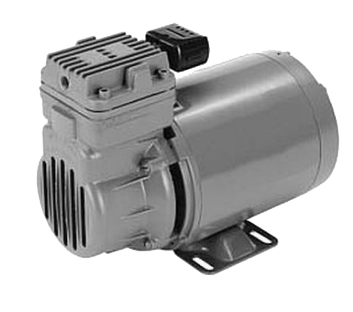
Articulated piston technology provides robust vacuum and pressure performance where laboratory or scientific equipment requires a compact integrated pump.
More Information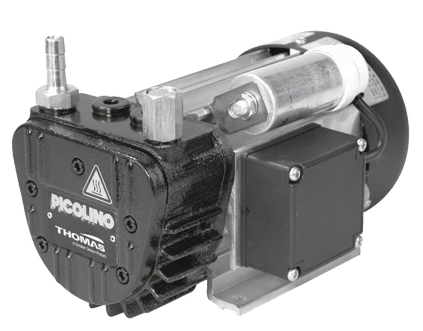
Rotary vane technology provides relatively high flow with low pulsation and vibration, making it useful for suitable laboratory gas handling and sampling applications.
More InformationLaboratory pump selection is rarely based on vacuum level alone. Noise, contamination, flow, duty cycle and package size can be equally important.
Oil-free pump technologies can reduce the risk of lubricant entering the pumped gas stream or laboratory environment.
Acoustic performance can be important where pumps operate directly beside users or inside bench-top instruments.
Smooth pump operation can be important around measurement equipment and sensitive analytical instruments.
Laboratory equipment often provides limited space for integrated vacuum and pressure components.
The pump must maintain the required operating vacuum at the actual process flow rather than merely achieve a strong ultimate vacuum.
Pump technology should be matched to the expected duty cycle, operating hours and required equipment life.
Thomas diaphragm technologies cover a broad range of compact vacuum and pressure applications. Final pump selection depends on the specific model and operating point.
Compact flow capability for small analytical and laboratory systems.
Larger diaphragm platforms can support substantially higher gas flow.
Selected diaphragm technologies can provide pressure up to approximately 43.5 PSI.
Selected models can achieve vacuum approaching approximately 29.2 inHg.
Multiple Thomas technologies operate without lubricating oil in the pumped gas path.
Compact pumps designed for integration into laboratory and analytical equipment.
The correct laboratory pump should be selected around the actual operating point and the requirements of the complete instrument or process.
The broad range of Thomas pump technologies allows laboratory equipment designers to balance vacuum, pressure, flow, size, noise and operating life.
High performance relative to physical size supports integration into bench-top and OEM laboratory equipment.
Multiple Thomas product families provide clean pressure and vacuum without lubricating oil in the pumped gas stream.
Linear diaphragm technologies can be particularly useful for laboratory equipment where acoustic performance matters.
Different pump technologies cover low-flow analytical duties through higher-flow laboratory and scientific equipment.
Thomas product families support both vacuum generation and positive-pressure applications.
CompreVac can help match pump technology to required vacuum, pressure, flow, duty cycle, noise and physical constraints.
Common questions about Thomas laboratory vacuum pumps, compressors and pump selection for scientific and analytical equipment.
The best laboratory vacuum pump depends on required vacuum level, flow, gas compatibility, operating hours, noise and contamination requirements. Oil-free diaphragm pumps are common in many laboratory applications, but piston, linear diaphragm and rotary vane technologies may be more appropriate for other duties.
Yes. Thomas offers multiple oil-free pump technologies including diaphragm, linear diaphragm and selected piston designs for clean vacuum and pressure applications.
The Thomas diaphragm portfolio includes models capable of vacuum levels approaching approximately -990 mbar, or about 29.2 inHg. Actual performance depends on the specific pump and operating flow.
Thomas vacuum pumps can be suitable for laboratory filtration equipment where the selected pump provides the required vacuum and flow and its materials are compatible with the gases or vapours being handled.
Yes. Compact diaphragm and rotary vane technologies can be used in suitable gas-sampling and analytical applications where controlled airflow or vacuum is required.
Linear diaphragm pumps are particularly relevant where low noise and low vibration are important. Final selection should still consider required flow, pressure or vacuum and duty cycle.
An oil-free laboratory vacuum pump produces vacuum without using lubricating oil inside the pumped gas path. This can reduce the risk of oil contamination and simplifies maintenance for many laboratory applications.
Thomas offers pump technologies and configurations for vacuum and positive-pressure applications. The correct configuration depends on the required operating point and equipment design.
Thomas compact pumps are widely suited to OEM-style equipment where vacuum, pressure or gas flow must be integrated into a small instrument package. Pump selection should be based on the individual analytical application.
Start with the required operating vacuum and gas flow, then consider duty cycle, chamber or system volume, evacuation time, gas compatibility, noise, available space and electrical requirements.
Yes. Provide CompreVac with the existing pump model, required vacuum or pressure, flow, voltage, dimensions and application information. We can help identify an appropriate Thomas pump or replacement technology.
Yes. CompreVac can assist with pump selection based on vacuum, pressure, flow, duty cycle, motor voltage, noise, physical dimensions and the requirements of the laboratory or analytical equipment.
Send CompreVac the required vacuum, pressure, flow, duty cycle, voltage and application details. We can help identify the appropriate Thomas diaphragm, piston, linear diaphragm or rotary vane technology for your laboratory or analytical system.
Peristaltic pumps are your ally when you need to dose or dispense the fluid with high accuracy without cross-contamination. They can be used to pump a variety of liquids such as water, blood, sterile or aggressive fluids or suspended solid. More information
Thomas provides linear diaphragm pumps and compressors to OEMs for a broad range of medical, environmental, and industrial applications. Thomas oil-free linear pumps and compressors are the best choice for pressure and/or vacuum applications that require oil and contaminant-free air, compact designs, high efficiency, low power consumption, and very low noise levels.
More information
Thomas piston pumps utilize proprietary WOB-L® pump technology from Gardner Denver. WOB-L® piston pumps can provide higher pressure and flow capabilities than many other pump technologies, in a much smaller package. They cover a wide range of applications due to the breadth of product platforms and performance capability. More information
Rotary vane pumps are often the first choice for vacuum handling and gas sampling applications that require a high flow capability relative to the size of the pump.
Rotary vane technology features low pulsation and low vibration, which enable consistent flow rates with minimal vibration. These traits make these units ideal for Medical, Lab Life Science devices, life-saving equipment, and Industrial, Environmental, and Food & Beverage markets.
More information
Thomas’ diaphragm vacuum pumps and compressors are characterized by an excellent size to performance ratio. A leak-tight air path and stable performance over a lifetime complete the picture.
The overall portfolio includes a number of product lines. Flow rates range from 530 ml/min (0.018 cfm) to 90 l/min (3.2 cfm). The pneumatic performance covers pressures up to 3 bar (43.5 psi) and vacuum levels up to -990 mbar (29.2 in.Hg). Various motor options address lifetime requirements.More information