
Selling and servicing all makes of air compressors and vacuum pumps across Canada since 1975. A company you can trust. A company with integrity. CompreVac Inc.

VACUUMIZE industrial dry screw vacuum pumps combine clean, oil-free compression with constant-pitch and continuous-variable-pitch screw rotor technologies.
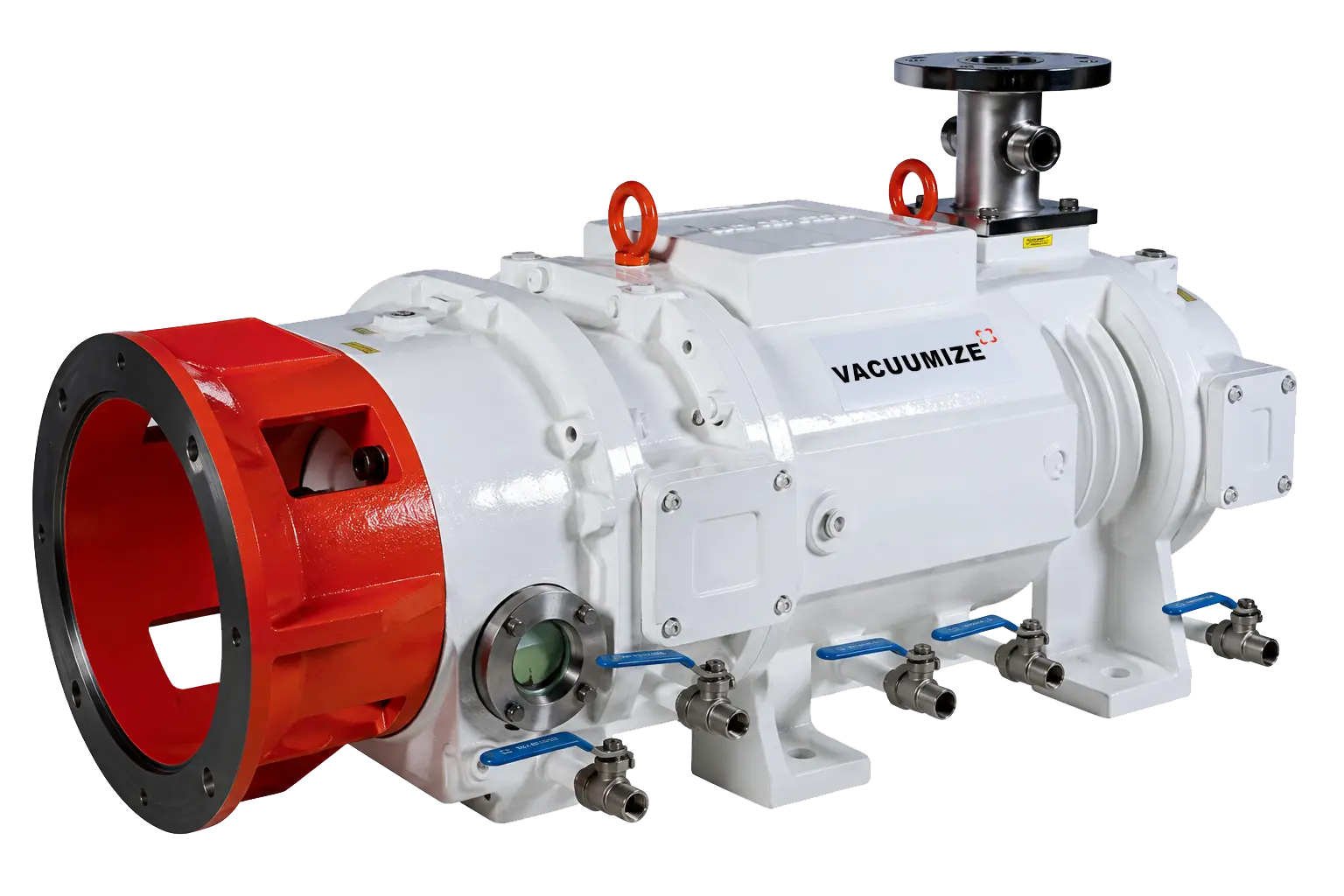
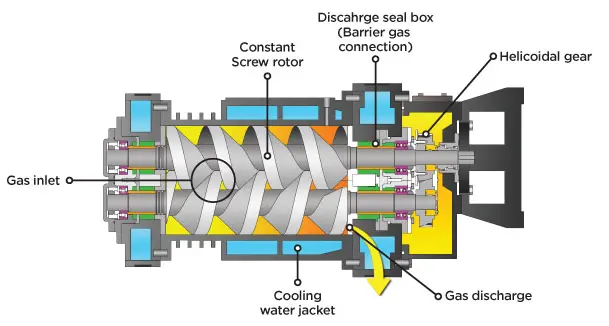
Both pump families use synchronized, non-contact screw rotors. The fundamental difference is how the screw pitch changes as gas travels from the inlet toward the discharge.
The VDP-C uses a constant screw pitch through the compression chamber to transport process gas axially through the pump.
The VDP-V uses an integral continuous-variable-pitch screw rotor. The changing geometry progressively manages trapped gas volume as the gas approaches the discharge.
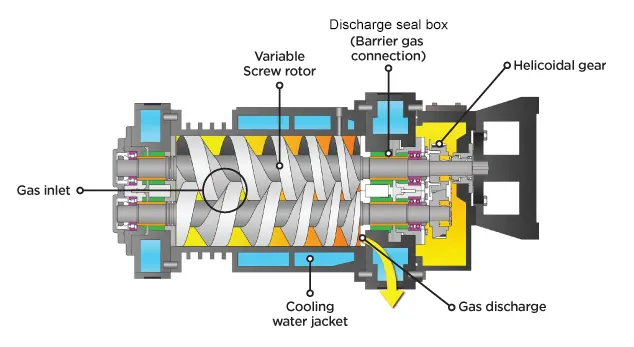
Continuous-variable-pitch rotor geometry progressively changes the trapped gas volume as it travels through the pump, improving internal compression efficiency.
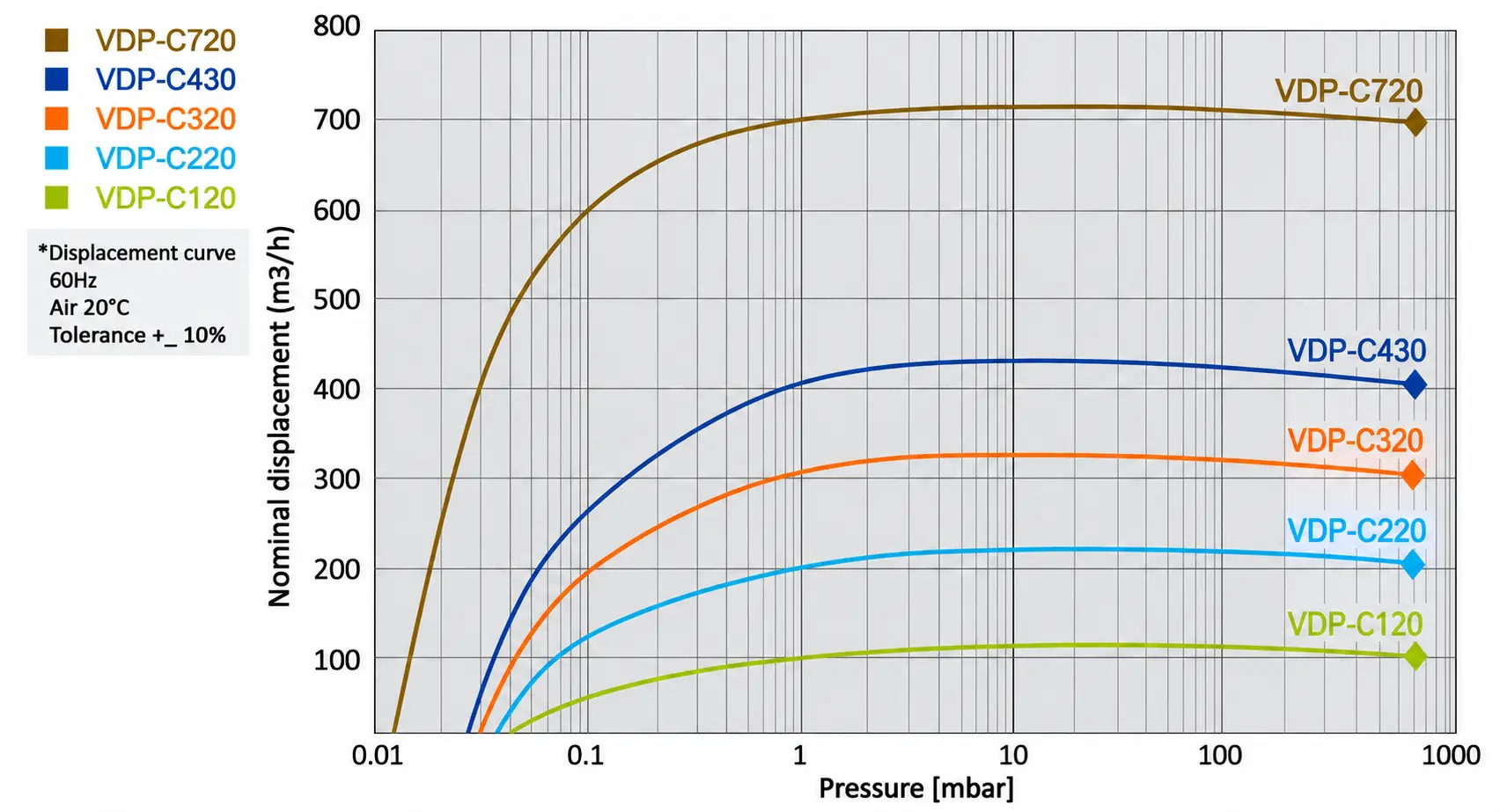
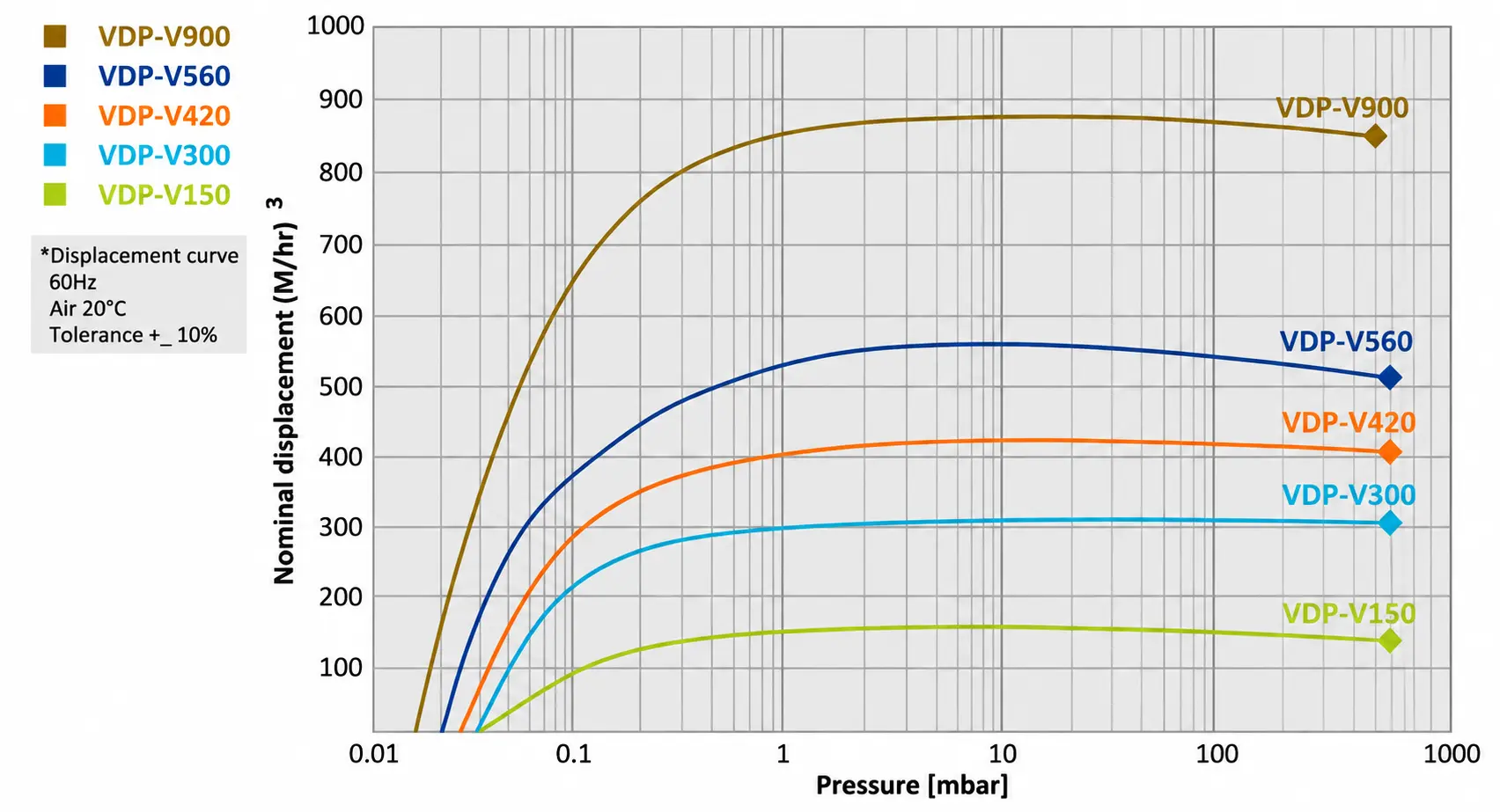
Published manufacturer performance curves show nominal displacement versus absolute inlet pressure for the VDP-C constant-pitch and VDP-V variable-pitch pump ranges.
Nominal displacement versus absolute inlet pressure for the 60 Hz VDP-C range.
Nominal displacement versus absolute inlet pressure for the extended 60 Hz VDP-V range.
Use the general arrangement drawing together with the dimensional tables when evaluating pump installation, connection positions and available equipment space.
Dimensions A through L correspond with the dimensional tables below. M and N identify the published inlet and outlet connection sizes.
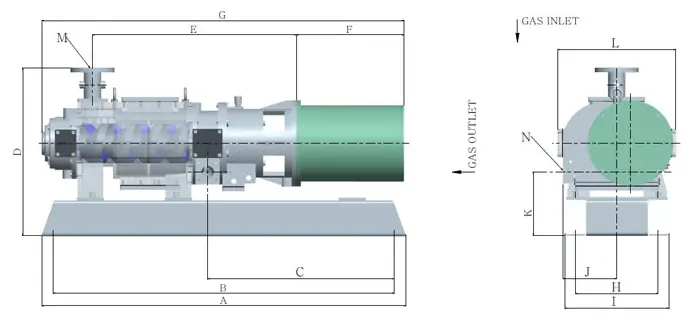
Published installation dimensions for the VDP-C constant-pitch dry screw vacuum pump range.
| Model | A | B | C | D | E | F | G | H | I | J | K | L | M | N |
|---|---|---|---|---|---|---|---|---|---|---|---|---|---|---|
| VDP-C120 | 960 | 900 | 570 | 420 | 240 | 600 | 950 | 240 | 290 | 160 | 100 | 320 | 40A | 40A |
| VDP-C220 | 1280 | 1200 | 656 | 618 | 405 | 690 | 1312 | 290 | 366 | 190 | 223 | 405 | 50A | 40A |
| VDP-C330 | 1480 | 1400 | 802 | 619 | 442 | 847 | 1415 | 331 | 406 | 194 | 212 | 438 | 50A | 40A |
| VDP-C430 | 1525 | 1445 | 819 | 665 | 485 | 859 | 1543 | 341 | 416 | 205 | 245 | 454 | 65A | 50A |
| VDP-C760 | 1860 | 1780 | 964 | 797 | 563 | 970 | 1796 | 437 | 537 | 258 | 270 | 530 | 100A | 80A |
Published installation dimensions for the VDP-V continuous-variable-pitch dry screw vacuum pump range.
| Model | A | B | C | D | E | F | G | H | I | J | K | L | M | N |
|---|---|---|---|---|---|---|---|---|---|---|---|---|---|---|
| VDP-V150 | 960 | 900 | 570 | 420 | 240 | 600 | 950 | 240 | 290 | 160 | 100 | 320 | 40A | 40A |
| VDP-V300 | 1230 | 1130 | 600 | 618 | 385 | 690 | 1300 | 290 | 366 | 190 | 195 | 390 | 50A | 40A |
| VDP-V420 | 1390 | 1290 | 750 | 619 | 424 | 847 | 1400 | 331 | 406 | 194 | 200 | 415 | 50A | 40A |
| VDP-V560 | 1420 | 1320 | 770 | 665 | 450 | 859 | 1450 | 341 | 416 | 205 | 225 | 425 | 65A | 50A |
| VDP-V900 | 1700 | 1600 | 865 | 797 | 515 | 970 | 1720 | 437 | 537 | 258 | 245 | 480 | 100A | 80A |
Dry screw technology is suited to applications requiring clean compression, process-gas handling and reliable industrial vacuum generation.
Dry vacuum generation for compatible process gases, vapours and chemical duties.
Moisture and volatile-material removal under controlled vacuum conditions.
Vacuum generation for separation processes operating below atmospheric pressure.
Dry vacuum generation for compatible manufacturing and electronics processes.
Screw technology suited to compatible condensables, vapour loads and process gases.
Integration into dedicated or centralized industrial vacuum systems.
CompreVac can evaluate the actual application and determine which VACUUMIZE dry screw technology and pump size is appropriate for the process.
Send CompreVac your required vacuum level, pumping capacity, process conditions and gas load and we can help select the appropriate constant- or variable-pitch VACUUMIZE pump.

Operating Principle V-Series
Pressure increase by volume reduction is the principle behind rotary vane operation. In a cylindrical housing a rotor is positioned eccentrically so that it is on the top almost touching the cylinder. Rotor blades or vanes as they are called, are positioned inside rotor slots.
When the rotor starts turning, due to centrifugal force the blades are thrown out and slide against the internal surface of the cylinder. In this way a cell is formed between two blades with a volume that changes constantly during rotation. Air enters from the inlet port into a cell until the rear blade reaches the far end of the inlet port. At this point the cell has achieved its maximum air volume. As the cell then moves away from the port its volume becomes smaller and smaller, the air is thus compressed and the pressure rises. This continues until the pressure in the cell exceeds that in the pressure chamber and the compressed air then exits through the outlet port.
Some models are fitted with exhaust valves which stop the backflow of this discharged air if the maximum pressure has been reached. In a vacuum pump the process is similar, but the cell gives decreasing pressure, and the chamber is at atmospheric pressure. With pressure-vacuum pumps the lower end of the inlet port(s) for the vacuum is moved forward. The cell can now be filled through second inlet. To avoid impairing the vacuum, this second inlet port is located about one cell segment away from the main suction port. The ratio between vacuum and pressure capacities can be influenced by the choice of inlet port.

Elmo Rietschle Vane Pump V-VTE Series is a series of rotary vane vacuum pumps designed for use in a wide range of industrial applications. These pumps are known for their high performance, reliability, and energy efficiency.
Furthermore, with their small and compact design, they offer maximum installation flexibility.

Elmo Rietschle Sliding Vane Vacuum Pumps V-VTN are a type of positive displacement rotary vane vacuum pump designed for a range of industrial applications. These pumps are known for their high pumping speed, efficiency, and reliability.
Datasheet
The V-VTA series of pumps are commonly used in applications such as packaging, printing, plastics, woodworking, and many others where a reliable source of vacuum is required.
Datasheet
Elmo Rietschle Sliding Vane Vacuum Pumps V-VTR are a type of positive displacement rotary vane vacuum pump designed for a range of industrial applications. These pumps are known for their high pumping speed, efficiency, and reliability.
Datasheet